

Watch the video
Two purchase prices: $10 and $20. Their simple average is $15.
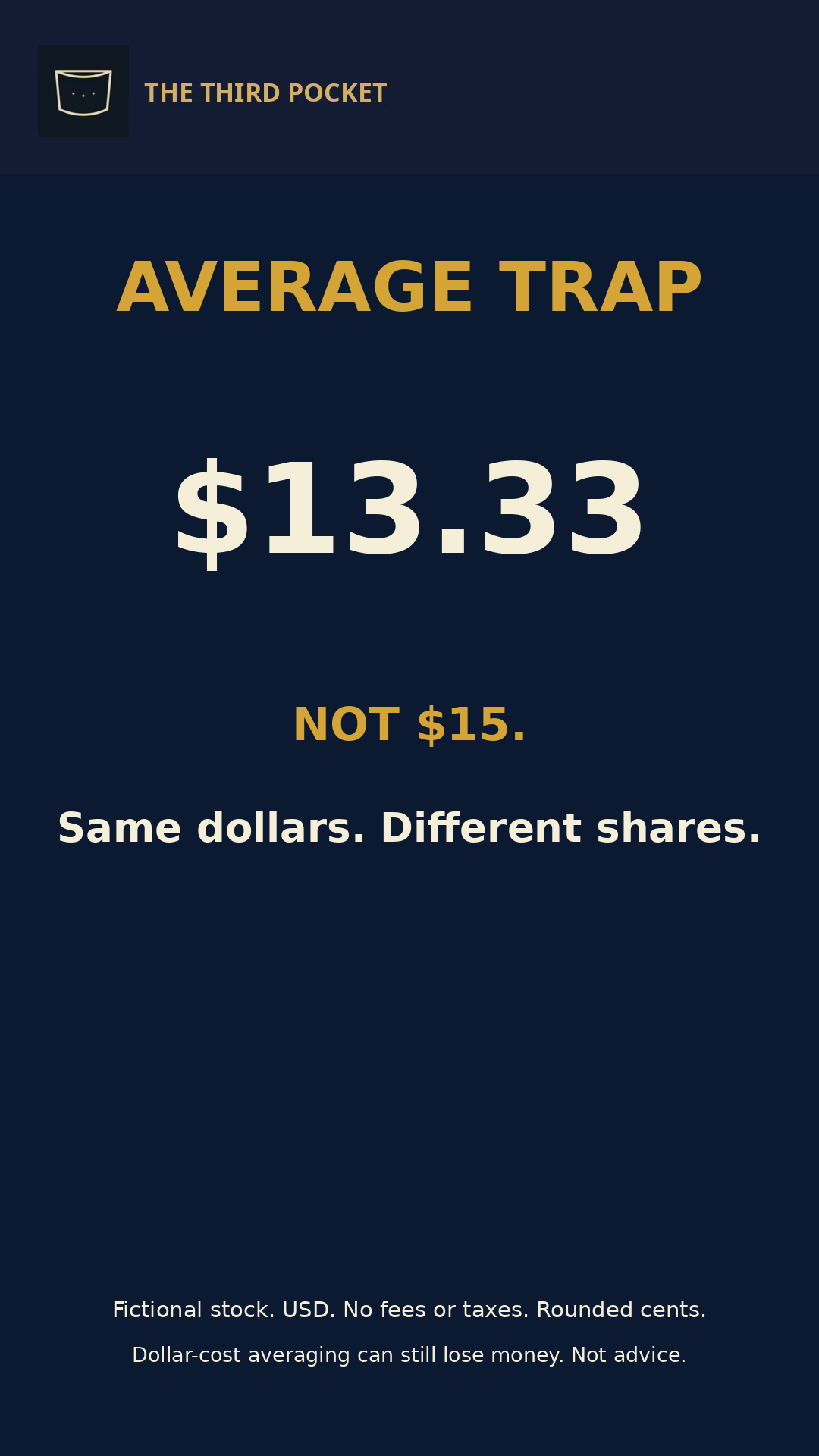
But invest a made-up $100 at each price and you buy 10 shares, then 5. Total cost: $200 for 15 shares, or $13.33 per share, rounded.
Equal dollars do not buy equal share counts. The cost per share uses total dollars divided by total shares. This does not establish a profit or protect against loss. No fees or taxes.
Not investment advice.
Why the two averages differ
An arithmetic mean gives each purchase price equal weight. Cost per share gives each share its actual cost weight. At the lower price, the same $100 buys twice as many shares. The fifteen shares therefore have a combined cost of $200, making the cost per share $13.3333 before rounding.
A lower average cost is not a return
The example is not a prediction of future prices. If all shares later trade below their cost, the investment can still lose money. Two equal-dollar purchases alone do not establish that an investor followed a long-term scheduled plan. Fees and taxes are excluded here.
Explore further
Explore more money mechanisms in The Third Pocket newsletter.