
Watch the short answer
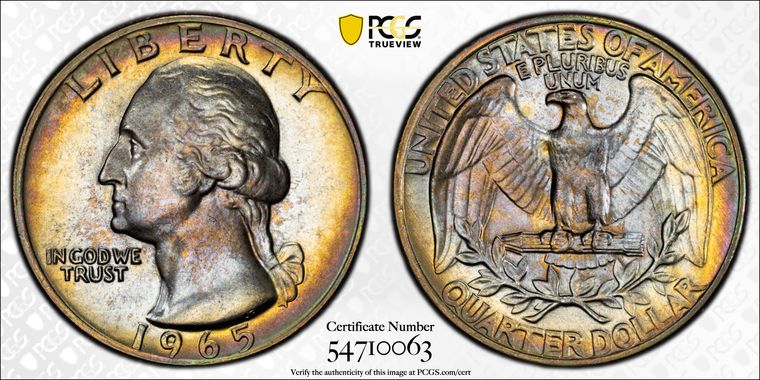
Why 1965 is the date people check
1965 sits at a change in US coinage. PCGS records that the Coinage Act of 1965 replaced the silver composition of regular quarters with a copper core bonded to outer layers of 75% copper and 25% nickel. The new quarter did not become a silver coin simply because it was made near that transition.
PCGS lists 1,819,717,540 regular-strike 1965 quarters. That is a production count, not the number surviving today. The date alone is therefore a weak rarity signal. A valuable exception needs an extra fact: an unusual authenticated mint error, an exceptional grade or a distinct strike type.
No mint mark is normal
A missing mint mark on a 1965 quarter is not an error by itself. PCGS explains that mint marks were suspended during this period to discourage hoarding. Its history records regular production at Philadelphia and Denver, so no mint mark does not let you assign every 1965 quarter to Philadelphia.
Special Mint Set quarters are another category. PCGS describes the 1965 SMS issue as a special strike, made with specially prepared dies and a satin-like appearance. A shiny coin is not enough to call it SMS. Strike identification and condition should be settled before comparing it with a price guide or sale.
Weight and edge: useful clues, not a verdict
The US Mint's quarter specification is 5.67 grams. PCGS gives the same weight for the regular 1965 issue. A visible copper-colored band at the edge is consistent with the copper-core clad construction.
Look without scraping, filing or polishing the coin. Use a precise scale, and treat a measurement as a screening clue rather than a metal assay. Wear, damage, deposits and measurement error can complicate interpretation. An unusual result is a reason to ask an expert, not permission to label the coin a silver error.
PCGS's October 5, 2017 report on unusual quarter errors explicitly says that a few 1965 silver quarters are known. That confirms the exception exists. It does not establish that a coin in your hand is one of them, or give it a current price.
Worked example: an ordinary-looking quarter
Assume you have a circulated 1965 quarter with no mint mark, a copper-colored edge and a reading near 5.67 grams on a checked scale. Those observations fit the regular clad issue. The missing mint mark adds no rarity claim.
Now change one observation: the edge looks uniformly pale or the weight seems unusual. The answer is not "silver." Record the weight, take clear front, back and edge photographs, and ask a coin specialist to check composition and authenticity. This example classifies the next question; it does not appraise the coin.
Why a record sale is not your coin's value
A sale of a certified high-grade coin or a rare error is a sale of that particular specimen. Grade, strike, surfaces and authentication matter. A worn pocket-change example cannot inherit the price of a top-grade auction coin just by sharing its year.
We have not verified a current grade-by-grade dealer-buying table for this article. The face denomination is 25 cents; any collectible premium needs a properly identified coin and a current comparable sale or offer. Asking prices are not the same as completed sales. Before paying for grading, check the total fee against a realistic premium for the identified type.
The practical payoff: identify the metal and strike first. Then identify condition. Only then ask about price.
Common questions
Is every 1965 quarter silver?
No. The regular issue is copper-nickel clad over a copper core. PCGS reports a few silver-planchet errors, which are exceptions requiring authentication.
Is a 1965 quarter with no mint mark rare?
Not for that reason. Mint marks were suspended in this period; absence alone is normal.
Does 5.67 grams prove a quarter is genuine?
No. It is the standard clad weight and a useful check, not authentication or a composition test.
Is an SMS quarter the same as a silver error?
No. Special Mint Set is a strike category. PCGS identifies the 1965 SMS quarter as clad; a silver-planchet error concerns the blank used to strike a coin.
Should I clean it before taking photos?
No. The US Mint warns that polishing or cleaning coins can reduce their value. Handle it by the edges and preserve the surfaces.
Keep reading
Is a 1980 penny valuable because it is copper?
Price something in gold ounces: compare a price in metal units without confusing metal content with collectible rarity.
Sources checked October 7, 2026
- PCGS CoinFacts, regular issue: specs, mintage and mintmark history: https://www.pcgs.com/coinfacts/coin/1965-25c/5878
- US Mint, Coin Specifications: standard quarter weight: https://www.usmint.gov/learn/coin-and-medal-programs/coin-specifications
- PCGS CoinFacts, 1965 SMS quarter: separate strike type: https://www.pcgs.com/coinfacts/coin/1965-25c-sms/5997
- PCGS, October 5, 2017: a few 1965 silver quarters are known: https://www.pcgs.com/news/pcgs-certifies-rare-quarter-errors
- US Mint, Caring for Your Coin Collection: https://www.usmint.gov/learn/collecting-basics/caring-for-your-coin-collection
- PCGS specimen certification: https://www.pcgs.com/cert/54710063
- PCGS TrueView photo terms: https://www.pcgs.com/trueview
Limits
Educational information, not a coin appraisal, investment recommendation or legal advice. Specifications describe the identified issue; they do not authenticate your specimen. No current collectible price table or sale outcome is claimed. Claims not independently verified would carry an asterisk and be explained here.