
Watch the short answer
Copper content and collector value are different questions
PCGS lists the no-mintmark 1980 Lincoln cent at 3.11 grams, with 95% copper and 5% zinc. That answers what the regular coin was made from. It does not answer what a buyer will pay for a specific specimen.
A coin can be common even when its metal content attracts attention. PCGS records more than 7.4 billion no-mintmark 1980 cents. That count belongs to this issue, not to every 1980 cent across all mints, and it is not a count of coins surviving in a particular grade today.
Three numbers get mixed up online: face value, theoretical metal value and collector value. Face value is the denomination. Metal value depends on an assumed commodity price and recoverable metal. Collector value depends on the identified coin, condition and market. One is not a substitute for another.
Start with the mint mark, not a jackpot headline
The no-mintmark issue and the 1980-D issue need separate comparisons. PCGS lists 5,140,098,660 for the Denver regular strike, also with a standard weight of 3.11 grams. Do not attach the 7.4 billion figure or the no-mintmark rarity commentary to a D-marked coin.
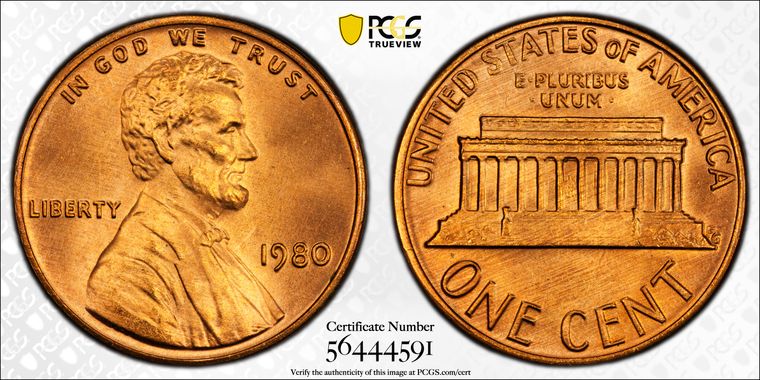
Record the date and any mint mark under it, then photograph both sides. If a mark or strike looks unusual, identify that type before applying a regular-strike guide. No mint mark on the issue pictured here is normal, not a valuable missing-mark error.
Why one grade step can change the comparison
PCGS's Jaime Hernandez says the no-mintmark 1980 cent is easy to locate through MS66, scarce at MS67 and rare above MS67. That is a statement about condition rarity, not a promise of a sale price.
MS means Mint State, an uncirculated grade category. A circulated cent does not become Mint State because it is old or shiny. CoinFacts also separates red, red-brown and brown designations. A price attached to a red high-grade specimen should not be applied to a worn brown coin.
The photograph on this page is a certified MS68RD specimen. It illustrates a precisely identified coin. It does not show what your coin would grade, and it is not an example of the MS66/MS67 comparison in the video.
Worked example: copper mass, not a cash offer
Assume an unworn regular 1980 no-mintmark cent matches the published 3.11-gram weight and 95% copper composition. The copper portion is 3.11 × 0.95 = 2.9545 grams, or about 2.95 grams. Ten such coins contain about 29.55 grams of copper under the same assumptions.
This is composition math, not a dealer quote, a melt-profit calculation or a valuation. Real wear can change mass. There is no commodity price, recovery cost or buyer offer in the example.
Do not turn a copper calculation into a melting plan
Current US rules in 31 CFR Part 82 generally prohibit exporting, melting or treating one-cent and five-cent coins, subject to listed exceptions and licensed authorization. The exceptions have specific conditions; a metal-value calculation is not permission to melt coins for profit.
This page does not interpret an exception for your situation. Read the current rule rather than treating an old video or a melt-value calculator as legal guidance. Copper content can be interesting without being a cash-out route.
What to check before believing a big price
Identify the mint mark, strike type, surfaces and any suspected variety or error. Compare actual completed sales of the same identified type and similar certified condition, rather than the most dramatic asking price you can find.
No current guide-dollar table has been independently checked for this page, so we do not assign your coin a collectible value. A grading or authentication service also costs money; check the whole fee against a plausible premium before submitting a common coin.
The payoff is simple: copper is a composition fact. Rarity is a separate claim. Condition is often the missing bridge between an ordinary penny and a collector comparison.
Common questions
How much copper is in a 1980 penny?
For the no-mintmark regular issue, PCGS specifies 95% copper and a 3.11-gram standard weight. That implies about 2.95 grams of copper before allowing for wear.
Are all 1980 pennies covered by the 7.4 billion mintage?
No. That is the no-mintmark issue. PCGS separately lists 5,140,098,660 for the 1980-D regular strike.
Does MS67 scarcity mean my penny is worth a large amount?
No. First establish whether it is that issue and actually that grade. PCGS rarity commentary does not grade your coin or promise an offer.
Can I melt pennies because the copper is worth something?
Not as a general assumption. 31 CFR Part 82 prohibits melting, export and treatment of these coins subject to specific exceptions and authorization. Check the current rule.
Should I polish a brown penny to make it red?
No. Do not try to create a grade or color designation by altering surfaces. The US Mint warns that cleaning and polishing can reduce coin value.
Keep reading
Is a 1965 quarter worth more than 25 cents?
Price something in gold ounces: compare a price in metal units without confusing metal content with collectible rarity.
Sources checked October 7, 2026
- PCGS CoinFacts, 1980 no-mintmark RD regular strike: specs and rarity commentary: https://www.pcgs.com/coinfacts/coin/1980-1c-rd/3001
- PCGS CoinFacts, 1980-D: separate issue and mintage: https://www.pcgs.com/coinfacts/coin/1980-d-1c-rd/3004
- eCFR, current 31 CFR Part 82: coin melting/export rules and exceptions: https://www.ecfr.gov/current/title-31/subtitle-B/chapter-I/part-82
- US Mint, Caring for Your Coin Collection: https://www.usmint.gov/learn/collecting-basics/caring-for-your-coin-collection
- PCGS specimen certification: https://www.pcgs.com/cert/56444591
- PCGS TrueView photo terms: https://www.pcgs.com/trueview
Limits
Educational information, not a coin appraisal, investment recommendation or legal advice. Specifications describe the identified issue; they do not authenticate your specimen. No current collectible price table or sale outcome is claimed. Claims not independently verified would carry an asterisk and be explained here.